
I’m hitting that time of midlife—my late 40’s where I start to evaluate the time I have left in the workforce. I’ve worked for various levels of government under many different leaders. I can’t say that I’m at the top of my career, but I think I’m close. I’m considered a leader and an expert in my field.
While most of my contemporaries are looking for the next step up in their respective fields, I’m looking down. In fact, I’m looking at restarting in a sense. You see, I worked in the high-pressure corporate world as a communications director doing the “on-call 24/7” thing and it just about broke me. I just about lost myself, my family, and, even today, my mental health still needs work.
But they say, “out of adversity, comes opportunity.” Like many, the impacts of the pandemic and subsequent changes in society took its toll on me and forced me to see things differently. I had to take some time away to survive, but it was in that time where my mind was allowed to dream about what could be.
The basis of an idea
Often, we dream during times of relaxation and happiness, but my dreaming was done in a time of pain and sorrow. I was in a place where confidence in my chosen vocation was destroyed, and I wasn’t sure how to move on. But in that insecurity, I was able to remove what I had done in the past from my thought processes and truly think about what else I could do with my life. In essence, I had stopped depending on my past career experiences for guidance on my future; I realized I had many other areas of my life I could learn from.
Many years before, I had taken up the hobby of woodworking and then woodturning. I have made many pieces of furniture and turned many items as well. My shop was a place where I could collect my thoughts, explore creativity, and really revive myself through the act of making.
Pushing this idea forward, I thought about how the simple act of making a pen changed someone. A family very close to mine has a son who was also struggling. One day, he visited me in my shop, and I taught him how to make a pen. The joy this brought him during a time of great pain was so incredible. You could see it in his eyes, his face, his entire being. He shared that joy with his parents and grandparents, who, in turn were very thankful. I could see there was more to this, and I started to think about how this art of making could impact others.
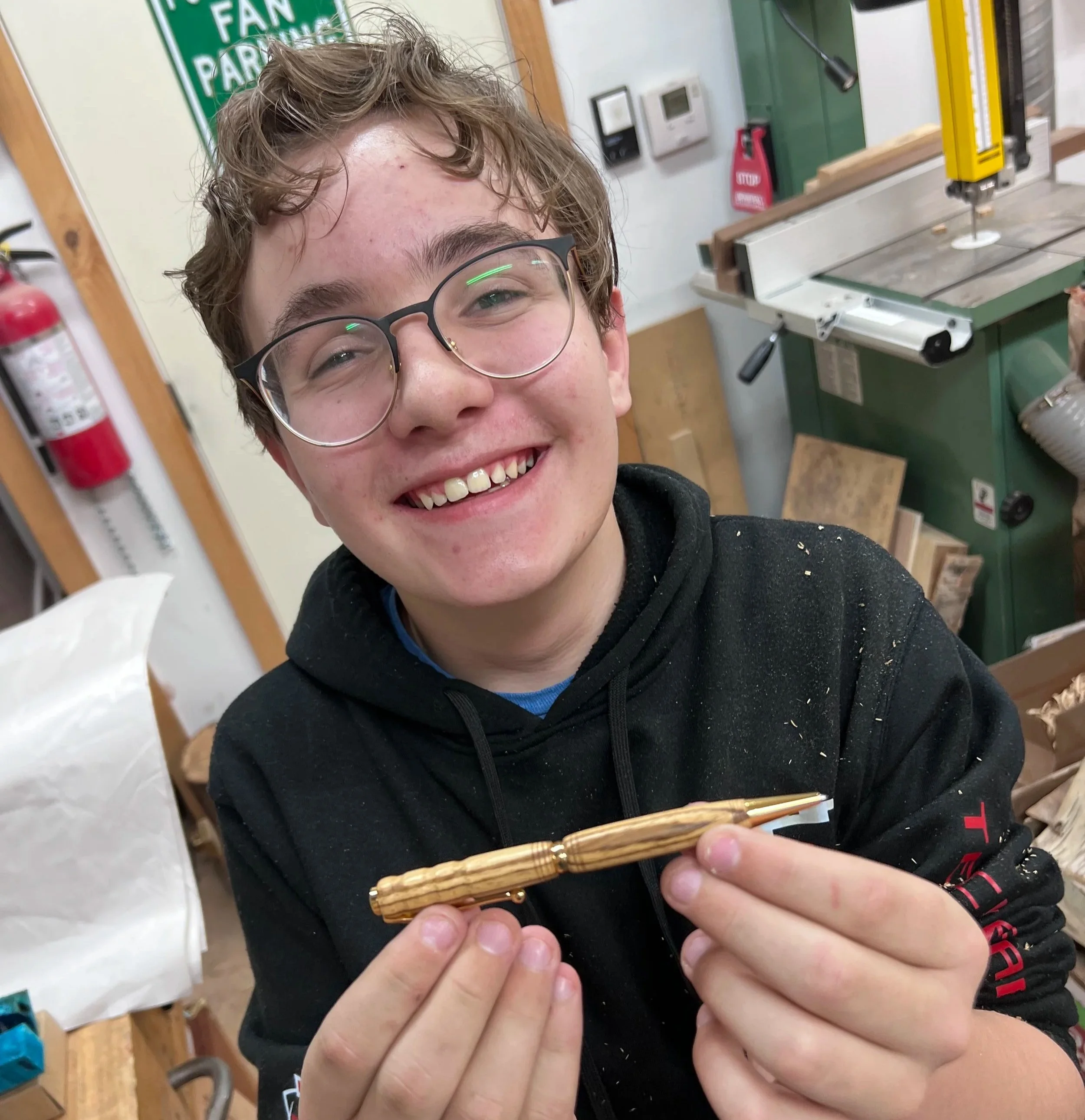
Seth after making his first pen.
Because of my work situation, I began thinking about how I could take this idea and perhaps make a shift. I started a business plan that you would never call a business plan. Even with excitement and passion driving me, I had no clue what I was doing. I searched the internet looking for guidance and trying to find out how I could build this idea into a feasible business, one I could maybe even be able to support my family with. I contacted Business Link in Edmonton, I read and listened to books, and finally landed on an idea for a non-profit.
The business would use woodturning as a foundation to bring in both youth and potentially people exiting the justice system. My thought was that those who had never had the opportunity to make something with their own hands could really benefit from the experience. Often, these groups have had challenging experiences in life and could use something (and someone) to help build their worth back into their lives.
I ran the idea by people who I trusted and there were many who thought it was a solid idea. The problem was I didn’t have the capital or the skills to make it into a viable business. It also terrified me to leave the security of my government job and jump head-first into a non-profit business with no guarantee of success. I’m just not wired this way.
My idea was shelved.
Thankfully, and amazingly, I began to rebuild my mental health. I found a new place to work to rebuild the areas of my life I had neglected. I became closer to my kids, my wife and my friends. I also had time to think.
With the mess in my head fading into the background, I thought about my idea to help people with woodturning. I knew I couldn’t start a new business, but I realized that I was drawn back to the books I read during my time getting my masters degree and developing my thesis.
My first academic experience
In 2018, I started the journey to get some kind of degree. I was on track to get a leadership position at work and the only thing standing in my way was my education (or lack thereof). Through many different iterances, I discovered the Flexible Admission program at Royal Roads University in Victoria, BC and was accepted into the Master of Arts in Professional Communications (MAPC) program.
The program allows for three options: course-based, research project, or thesis. I had never thought about pursing a thesis for this degree—I had fully intended to take the course route and get through the program that way, but thanks to inspirational professors and support from the school, I decided to take the thesis track. My eyes were truly opened to the power and potential of academic research.
The main reason for this choice was my topic. I had assumed, as a new student, that your thesis should be based on your vocation; for me, that would have been either communications or law enforcement. Thankfully, one of my professors set me straight. She highlighted that my thesis could be anything, and I asked if it could be about my hobby. She set me on a path of discovery that was eye-opening; I saw what the world of academe could be. No longer was it a complex world of theory no one could use, but it was a way to answer questions. It was a way that you could get to the heart of your curiosity with vigour and truth.
My hobby as a woodworker and woodturner was at the forefront of my thinking. I used my experience in woodworking as a foundation for exploring how other makers use their tools and materials. My supervisor and I developed a strong research question and proposal and completed my thesis in 2020. The YEG Makers Thesis explored how the maker engaged with the tools and materials they used in their craft. From that research, I learned how making goes far beyond the handmade item. There is growth in the maker themselves in the form of learning, confidence, joy, pride, etc.
A new idea
In the winter of 2024, my new job had significant changes coming. The healthcare industry in Alberta was in for years of transformation causing significant uncertainty. I had some time to evaluate once again, and my idea about a not-for-profit came back into my head.
However, I looked at it differently.
The thought came to me as I was reading some academic texts—I might be able to use this idea as a research project. What if I could use the idea of making to develop research on how it impacts those who have never had a “making experience” before? What if that could set people on a new path in their lives?
I wasn’t looking to develop vocational training—not many could be full-time woodturners. But that experience of making something had changed me and I had seen it change others before my eyes. But what was that?
I sent an email to my thesis supervisor from my masters and he whole-heartedly agreed with me. There was something to this question and he agreed to join me on this quest.
Formalizing the next steps
Since that time, I have applied and been accepted to the Doctor of Social Sciences program back at Royal Roads University. I have spent the last two years continuing to read academic literature, and doing all I can to prep for my entrance into the program. I have modified my ideas to better align with some of the theoretical methodological work my supervisor has done. I’m now focused on how making brings forth growth in the novice.
As I enter the program, this question will be further developed and ripped apart, but my hope remains the same: my research could help those who have never had a chance in life.
Perhaps this would still be people exiting the justice system or perhaps for youth who need something to be proud of. Honestly, that is all still to come, but I know there is something to this research and it is important and valuable.